Material Intelligence: What Titanium Aluminides, Inconel, and PEEK Actually Demand From a Machine Shop
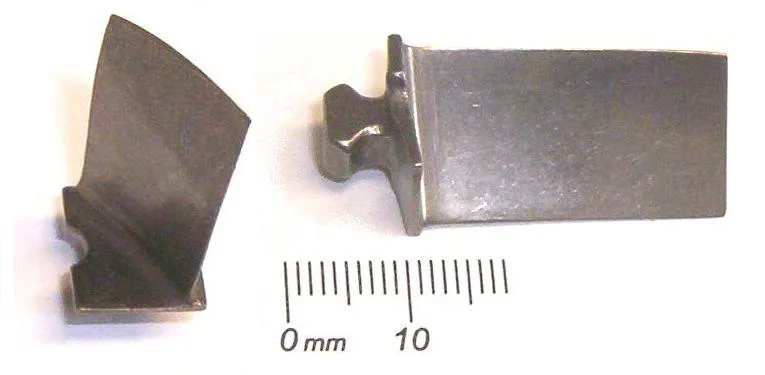
Photo: Ulfbastel, Public domain, via Wikimedia Commons
Every few years, a material makes the jump from research lab to production drawing, and the shops that survive the transition are the ones that treat the change as an engineering problem rather than a quoting problem. The current wave — driven by aerospace fuel-efficiency mandates, EV thermal management, and defense modernization — is forcing American precision machinists to rethink fundamentals. Here's what five of these materials actually demand, and one that we believe doesn't deserve its press.
Titanium Aluminides: Light, Strong, and Genuinely Difficult
Gamma titanium aluminide (γ-TiAl) earned its production credentials in the low-pressure turbine blades of the GEnx engine, and its weight savings at elevated temperature remain unmatched. But machining it is unforgiving. The material's low ductility and sensitivity to carbide insertion mean conventional turning strategies produce edge chipping and subsurface damage that scrapes parts at the final operation.
What a shop needs: rigid setups with minimal overhang, low cutting speeds paired with high-pressure coolant, and — critically — a process validated for subsurface integrity, not just dimensional conformance. Tolerance expectations should be realistic: γ-TiAl is not a material for heroic tolerances on thin-wall features. Buyers who demand ±0.0005" on unsupported aluminide geometry are buying scrap.
Inconel 625 vs. 718: Same Family, Different Problems
Inconel 718 remains the workhorse of hot-section and fastener machining — age-hardenable, weldable, and well understood. Inconel 625, with its higher molybdenum content, shows up increasingly in hydrogen and cryogenic applications tied to the energy transition. The distinction matters: 625's work-hardening behavior is more aggressive, demanding constant-engagement toolpaths that never let the cutter dwell. Shops still running interrupted, low-feed strategies on either alloy will burn through carbide and watch their per-part costs climb.
The inspection challenge is thermal. These alloys hold heat, and parts that measure in-spec on the machine can drift out of tolerance at room temperature. Serious shops build thermal soak time into their process, and buyers should expect that time reflected in lead times.
PEEK and Carbon-Filled Composites: A Different Discipline Entirely
PEEK compounds — especially carbon-fiber-filled grades — are displacing aluminum and even titanium in brackets, insulators, and EV battery components. Machining them well is a plastics discipline masquerading as a metals one. Heat is the enemy: excessive cutting temperatures cause delamination, burring, and dimensional instability in a material that wants to move as it cools. Sharp tooling, air-blast cooling, and fixturing that grips without stressing thin sections are non-negotiable. Tolerances tighten after machining as the part stabilizes — a shop that promises as-machined ±0.001" on filled PEEK hasn't machined enough of it.
The Overhyped Candidate: Metal Matrix Composites
Aluminum metal matrix composites (MMCs) have been "the next big thing" for two decades. The silicon carbide reinforcement that gives them their stiffness also makes them extraordinarily abrasive — effectively machining tooling at the same time it machines the part. Polycrystalline diamond tooling mitigates but doesn't solve the economics. For the vast majority of precision applications, optimized 7075 or 7050 aluminum delivers the performance at a fraction of the machining cost. Unless your program genuinely requires the stiffness-to-weight ratio, treat MMC enthusiasm with skepticism.
What This Means for Buyers
The material on your drawing is a proxy for the capability of your supplier. Before awarding work involving any of these alloys, ask a shop not whether it has "machined Inconel," but how it validated its process for the specific grade, what tool wear data it collects, and how it handles thermal effects in inspection. The answers — or the absence of them — will tell you more than any capability list.