Buying Axes You Don't Need: The Quiet Cost of Over-Specified Machining Capacity
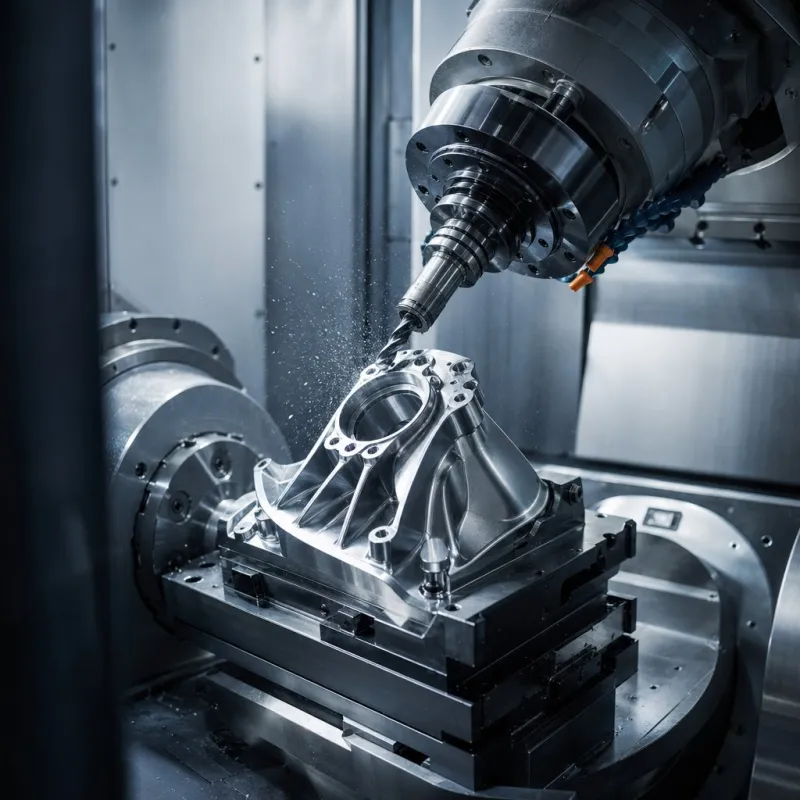
Photo: five axis CNC machine milling complex metal part manufacturing, via postimg.easyarticlemarketing.com
The Arms Race Problem
Visit enough machine shop websites and a pattern emerges: the equipment list has become the marketing centerpiece. Five-axis mills, mill-turn centers, Swiss lathes with live tooling — presented as though capability automatically transfers to your part, your tolerances, and your unit cost.
Here's an uncomfortable observation from the floor: a large fraction of parts quoted on five-axis machines would be better — cheaper, faster, and just as accurate — on a well-maintained three-axis mill with a smart workholding setup. More axes is not more quality. It is more flexibility, and flexibility carries a price tag that someone has to pay. That someone is usually you.
When Five-Axis Actually Earns Its Keep
Multi-axis machining is the right answer in specific, identifiable cases:
- Complex contiguous geometry. Impellers, blisks, orthopedic implants, and aerodynamic surfaces where tool access from multiple orientations eliminates setups and hand blending.
- Thin-wall and delicate features. Short, stiff tools enabled by simultaneous motion reduce chatter and deflection on features a three-axis setup can't reach cleanly.
- Set-up elimination on multi-face parts. A part requiring five operations on three machines can sometimes become one operation on one machine — reducing cumulative tolerance stack and handling risk.
- Exotic materials with tight windows. Aerospace alloys where every re-clamp risks distortion.
If your part doesn't resemble one of these cases, five-axis is likely a convenience for the shop, not a benefit for you.
How Buyers Overpay Without Noticing
The overcharge rarely appears as an explicit line item. Instead it hides in:
- Machine-hour rates. A five-axis center bills at a premium hourly rate. Two extra hours of programming and fixturing on the wrong platform can double the effective cost of a simple bracket.
- Programming overhead. Simultaneous five-axis CAM demands more engineering time, more verification, and more first-article iteration.
- Capability theater in quotes. Some shops route easy work through premium equipment because it's available, not because it's appropriate — then price accordingly.
The irony is sharp: the buyer who specified five-axis to signal sophistication often funds the machine payment without ever using its defining feature.
Questions That Reveal What You're Actually Buying
Ask any prospective supplier these four questions and listen carefully:
- "How would you fixture and machine this part, and why that platform?" A strong shop walks you through the reasoning — operations, workholding, tolerance flow. A shop selling machines talks about the machine.
- "What would this cost on a simpler setup, and what would we give up?" Honest vendors will run the comparison. Evasion tells you the quote is built on equipment, not engineering.
- "How many setups does this part need, and where does tolerance stack accumulate?" Process thinking beats platform thinking every time.
- "What's your utilization on that machine, and what runs on it typically?" A five-axis center that mostly cuts aluminum plates is a depreciating asset someone is paying for. Check whose invoice it lands on.
The Right Tool, Not the Best Tool
Precision machining is a discipline of matching method to requirement — tolerance, material, volume, and cost target all at once. A shop that recommends three-axis when three-axis is correct, and five-axis when the geometry demands it, is a shop thinking about your part. A shop that quotes everything on the newest machine in the building is thinking about its equipment schedule.
The best capability is the capability your part actually needs — and nothing more. Procurement teams who internalize that principle stop paying for spindle count and start paying for engineering judgment. That trade never loses money.