The Guess Before the Gauge: What a Model-Only Package Leaves Undefined at First Article
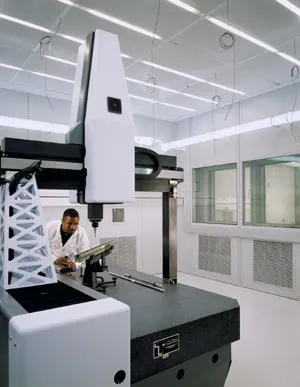
Photo: National Institute of Standards and Technology, Public domain, via Wikimedia Commons
An Argument Worth Having Before the Award
Model-based definition is not a novelty anymore. Digital product definition practices under ASME Y14.41 have been in industrial use for well over a decade, and a generation of engineers now designs in environments where the model is the authoritative geometry and the drawing is, at best, a summary. The efficiency argument is genuine: one dataset, one revision, no drift between views.
What follows is not an argument against model-based definition. It is an argument against treating the model as a complete definition when it is only a geometric one. A CAD model describes a nominal shape. It does not describe acceptable variation, it does not rank features by consequence, and it does not tell a machinist or a CMM programmer which surfaces the design cannot live without. Those are contractual statements, and a solid body cannot make them.
Where the Ambiguity Actually Lands
The cost of an underspecified definition does not appear at quote. It appears at the inspection bench, in the first article inspection, in the conversation that begins with a measurement and ends with a question about intent.
A shop receives a model, a material callout, and a finish specification. It builds a process. It chooses a workholding scheme, an order of operations, and a set of in-process checks. Every one of those choices embeds an assumption about what matters. If the model does not say that a bore is a bearing seat with a press fit, the shop may rough it in the same operation as a clearance hole and finish it on a machine selected for the clearance hole. If the model does not say that a mounting face is the datum, the shop may establish alignment on a surface that is convenient rather than functional.
None of this is negligence. It is the ordinary behavior of a competent supplier filling a gap that the definition left open. The gap becomes a dispute only when the first article is measured and two parties discover they were building to different parts.
Three Things a Model Cannot Say
Which features are critical. A model renders a tight-tolerance bore and a cosmetic chamfer with the same fidelity. Only a designation — a critical-to-quality flag, a characteristic classification, a note — communicates consequence. Without it, a shop allocates inspection time and machine capability evenly, which means over-inspecting the trivial and under-inspecting the important.
What the datum strategy is. Datum reference frames are a fixturing and inspection architecture, not a geometric property. The order of datum precedence determines how a part is held, how a CMM is aligned, and how the tolerance stack is computed. A model that does not declare datum features leaves the alignment decision to whoever programs the inspection routine, and that decision is not reproducible across suppliers or across years.
What variation is acceptable. This is the fundamental gap. A model is exact; manufacturing is not. Acceptance requires a tolerance, and a tolerance is a statement about the boundary of acceptable function. Absent one, the shop substitutes a default — typically whatever its process naturally holds — and that default is simultaneously too tight for the shop and unconnected to the design intent.
The Difference Between a Basic Dimension and a Missing One
A frequent confusion: model-based packages that include basic dimensions in brackets, or that carry a general note stating that untoleranced dimensions are basic. Basic dimensions are theoretically exact and carry no tolerance of their own; they exist to locate features within a feature control frame. A part defined entirely by basic dimensions with no geometric tolerances attached is not a tightly specified part. It is an unspecified one wearing the costume of precision.
This is where the elegance of the model becomes a liability. A drawing with a ±0.005 inch title block tolerance at least establishes a floor. A model with nothing but nominals establishes nothing.
The Contractual Half of the Problem
Even a well-formed model-based definition is only binding if the purchase order says it is. That requires, at minimum:
- A named dataset, with file name, revision, and release date.
- A statement that the dataset, not a derived drawing or a shop-generated 2D reference, is the controlling definition.
- A named standard — ASME Y14.41 and Y14.5, or ISO 1101 and its companion standards — governing interpretation of the PMI.
- A defined method for resolving conflicts between the model, the annotation, and any reference drawing.
- A defined acceptance process, including what the first article report must demonstrate and against what characteristics.
Without those five items, the shop is not working to a specification. It is working to an interpretation, and interpretation is not auditable.
A Practical Middle Path
The productive position is not to retreat to fully dimensioned drawings. It is to treat the model as the geometry and the annotation set as the contract. Practically, that means retaining a datum strategy, retaining explicit tolerances on functional features even if they are carried as annotation views attached to the model, designating critical characteristics, and referencing the whole assembly of that information in the purchase order.
The shop's side of the bargain is equally clear: when a package is silent, ask before quoting. A clarification request costs a day. A first article dispute costs a quarter, and the schedule damage is usually worse than the rework.
A model is a description of a shape. A contract is a description of acceptable outcomes. Conflating the two is not a technology problem — it is a definition problem, and it belongs to the party that owns the design.