The Relic in the Inspection Room: Recertifying Your Golden Sample Before It Lies to You
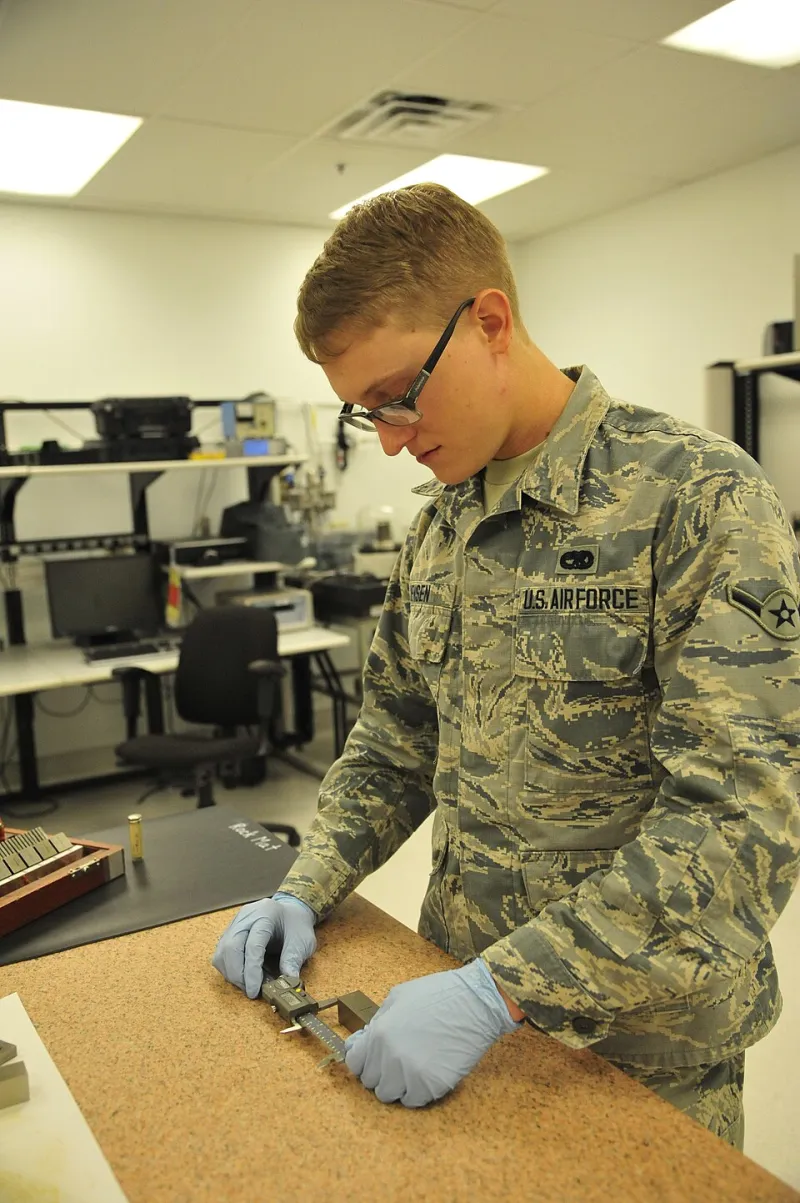
Photo: Senior Airman Grace Lee, Public domain, via Wikimedia Commons
The Part That Outlived Its Paperwork
Walk into the inspection room of most American machine shops and you will find it: a single part, sometimes in a padded case, sometimes in a zip-lock bag, labeled in fading marker. This is the golden sample — the physically approved reference against which every subsequent shipment is implicitly judged. It was signed, stamped, and photographed once, often years ago, and then quietly enshrined.
The trouble is that a golden sample is not a monument. It is a measurement instrument, and instruments drift. Tooling wears, inserts are re-sourced, CAM programs get revised after a crash, and a deburring hand changes. None of these events touch the sample. So the sample stays frozen in 2019 while the production part keeps moving. Eventually the two are different objects, and nobody on either side of the purchase order can say when the divergence happened.
How a Reference Becomes Folklore
The decay is rarely dramatic. It follows a familiar pattern:
- The silent tool change. A carbide grade is discontinued; the shop substitutes an equivalent. Dimensions hold, but a corner radius shifts by a few thou. The drawing says one thing, the sample says another, and the shop trusts the sample because it was the thing that got approved.
- The verbal amendment. An engineer emails the shop manager — "just ease that edge, the assembly fitter keeps complaining" — and no ECN is ever cut. The production parts change. The sample does not.
- The personnel cliff. The machinist who knew why that one bore is reamed instead of bored retires. The knowledge leaves; the undocumented deviation stays.
- The vendor handoff. Work is moved to a new supplier, who receives the sample as gospel. They faithfully reproduce the artifact — including its accumulated errors — rather than the drawing.
At that point, the golden sample is folklore: revered, cited, and entirely disconnected from the controlled document. Your incoming inspection may even be passing parts against the wrong reference, which means your quality system is certifying its own drift.
A Re-Baselining Protocol You Can Actually Enforce
The fix is procedural, not technological, and it belongs in your supplier quality agreement. We recommend the following four commitments be written into any multi-year machining contract:
1. Scheduled recertification. Require the golden sample to be re-measured against the current released drawing revision at a fixed interval — annually for tight-tolerance or safety-critical work, biennially otherwise. The result is a documented reconciliation: either the sample matches the drawing, or the drawing is formally updated, or the sample is retired and replaced.
2. A single source of dimensional truth. State plainly that the controlled drawing revision, not the physical artifact, governs in any conflict. The sample is evidence, not authority.
3. Custody documentation. The sample should have a chain-of-custody log — who holds it, where it is stored, every transfer, every measurement event. When work transitions between vendors, the sample moves with a signed handoff record, not a shipping label and a hope.
4. Replacement triggers. Define the events that force a new first article: a drawing revision, a tooling or process change, a facility move, or a change of subcontractor. A sample that has survived three of these without re-approval is not a reference; it is a liability.
What to Ask at Your Next Supplier Review
Procurement teams do not need to become metrologists to police this. Three questions will reveal most of what you need to know:
- "When was your golden sample last verified against the current drawing revision, and can I see the record?"
- "If your inspector and your sample disagree, which one wins — and where is that written?"
- "If we move this work to another shop tomorrow, what exactly travels with it?"
A shop with a mature quality system will answer within minutes and produce documents. A shop that goes quiet, or offers to "go check with the floor," has just told you the sample is folklore.
The Sample Is a Snapshot, Not a Contract
A golden sample captures one moment: one machine, one setup, one lot of material, one revision of a drawing. Everything else in manufacturing is allowed to change — and does. Treating the artifact as a permanent standard inverts the entire logic of documented quality control.
At Hongye Precision, we treat first-article references as living records: measured, logged, and re-baselined on schedule, with custody that transfers cleanly when programs change hands. Buyers who adopt the same discipline find that their incoming inspection gets sharper, their disputes get shorter, and their golden samples go back to doing the one job they were made for — telling the truth.