The Clock Behind the Quote: When Your Parts Run Determines What You Pay
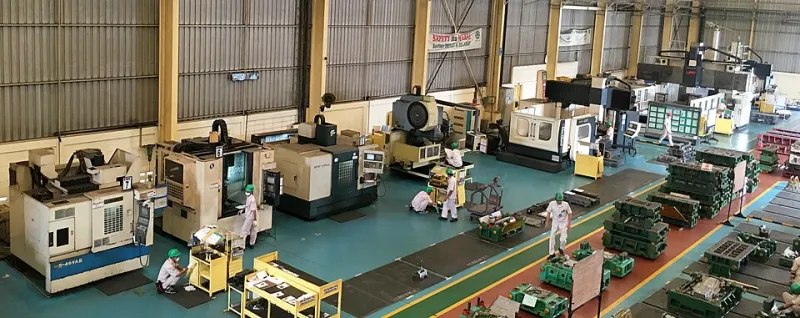
Photo: Antoniusaw, CC BY-SA 4.0, via Wikimedia Commons
Ask a machining supplier for a quote on a Monday morning and ask again on a Friday afternoon, and you may get two different numbers for the same print. Neither quote is dishonest. Both reflect the same labor rates, the same material costs, the same overhead. What differs is the calendar — and more specifically, where your parts would land on it.
Most procurement professionals treat scheduling as a downstream concern, something to negotiate after the price is agreed. In precision machining, the relationship runs the other way. Scheduling position is one of the primary inputs into price, and it is almost never discussed during RFQ negotiations. Understanding why is one of the more underused levers available to a buying team.
The Economics of an Empty Spindle
A CNC machining center has a fixed cost of existence: the lease payment, the floor space, the depreciation, the operator standing beside it. Every hour that spindle is not cutting is an unrecoverable loss. Shops manage this reality by structuring their quotes around machine loading — the percentage of available hours already committed to work in house.
When a shop is running hot, at or above ninety percent utilization, a new order competes with existing commitments. The quote reflects the cost of displacement: overtime premiums, the opportunity cost of delaying another customer, or the price of adding weekend hours. When a shop has idle capacity — a gap between jobs, a shift running light — the same order can be priced aggressively simply to keep the spindle turning.
Neither situation is a scam. But the buyer who doesn't understand the distinction will interpret a high quote as greed and a low quote as a bargain, when both are really just snapshots of someone else's production calendar.
Day Shift, Night Shift, and the Weekend Fill-In
The practical question a buyer should ask — and rarely does — is straightforward: when will my parts actually run?
There are three common answers, and each carries different implications.
Prime time. Parts scheduled on first shift run under the shop's most experienced supervision, with engineering and quality staff immediately available if a problem surfaces. This is the most expensive slot, and for tight-tolerance work or first articles, often the right one. A critical aerospace component machined at 2 PM with a process engineer down the hall is a different product than the same component machined at 2 AM with a skeleton crew.
Lights-out and night runs. Many shops run second and third shifts, or unattended overnight cycles, to amortize machine costs across more hours. Labor rates per part drop. But so does the density of oversight. If your drawing has a callout that depends on judgment — a hand-deburring note, an ambiguous datum interpretation — the overnight shift is where those ambiguities get resolved in ways you didn't specify. Night work is ideal for mature parts with proven programs and proven fixturing. It's a risk for anything new.
Weekend fill-in. Some of the most competitive quotes a shop issues are for work slotted into weekend hours, when the machines would otherwise sit idle and the premium labor is limited to a lean crew. This can be genuinely good pricing for straightforward jobs. It can also mean your parts are the lowest priority on the schedule — first to be bumped when a hot order from a bigger customer lands midweek.
What This Means for Delivery Risk
Scheduling position doesn't just affect price. It affects consistency and exposure.
A part that runs every cycle on the same shift, with the same operators, tends to show tighter process consistency — the small day-to-day variation that shows up in dimensional data and surface finish. A part that migrates between shifts, machines, and crews will usually show wider variation, even when every part is technically in tolerance.
And a part scheduled as a capacity filler carries delivery risk that no delivery date on a purchase order can fully insure against. Fill-in work is, by definition, the first thing rescheduled when the shop's mix changes. The lead time you were quoted assumed a calendar that no longer exists.
Questions That Surface the Real Schedule
Procurement teams don't need access to a vendor's ERP system to get at this information. A few pointed questions during qualification will do most of the work:
- "Which shift will this part run on, and is that the same shift that ran the first articles?"
- "What is your current machine loading on the equipment this job would use?"
- "If a higher-priority order arrives mid-production, what is your rescheduling policy — and how are customers notified?"
- "Are the operators running this part the same ones who proved out the process?"
A shop that answers these easily and specifically is telling you something important about its planning discipline. A shop that gets vague is telling you something too.
Timing Your Own RFQ
The corollary is that buyers can work the calendar themselves. If your part has flexibility — a longer lead time tolerance, a non-critical delivery window — saying so explicitly invites the vendor to slot it into open capacity and price accordingly. Conversely, if you need prime-shift attention for a first article or a tight-tolerance run, acknowledging that in the RFQ sets honest expectations on both sides and avoids the resentment that comes when a buyer expects first-shift quality at fill-in prices.
The quote you receive is not just a measure of a shop's cost structure. It is a measure of where your parts stand in someone else's week. Buyers who learn to read the clock behind the number negotiate better, plan better, and are far less surprised when the delivery date moves.
At Hongye Precision, we tell customers which shift their work runs on before they have to ask — because a price that comes with a schedule attached is a price you can actually plan around.