Reshoring Without Regret: A Five-Point Readiness Test Before You Bring Work Home
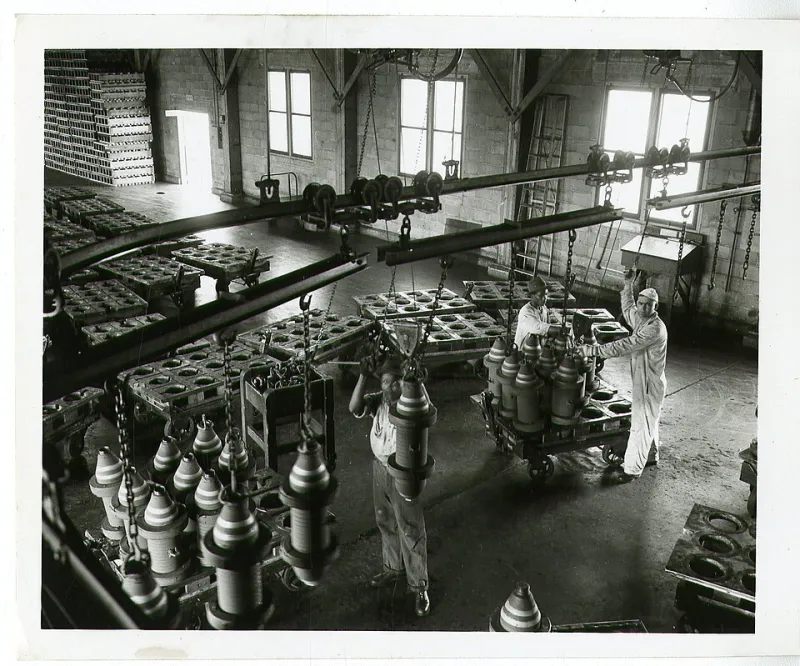
Photo: War Department. Office of the Chief of Ordnance. Cornhusker Ordnance Plant. 1942-9/18/1947, Public domain, via Wikimedia Commons
Reshoring is no longer a press-release talking point. Between tariff exposure, ocean freight volatility, and the geopolitical risk now priced into every long-term sourcing decision, procurement teams across the aerospace, medical device, and industrial equipment sectors are actively moving machined components back to US suppliers. The intent is sound. The execution, however, is where programs live or die.
The hard truth: relocating a purchase order does not relocate a supply chain. Shops that spent two decades absorbing commodity work overseas built their businesses around other product lines. When that work comes home, it lands in a domestic ecosystem with its own constraints — and buyers who assume stateside capacity is interchangeable with offshore volume are discovering those constraints the expensive way.
Gap One: Tooling and Raw Material Lead Times
The single most underestimated reshoring cost is not labor. It is lead time on the inputs. Domestic shops currently wait months for carbide tooling in common geometries, and specialty materials — certain stainless alloys, aerospace-grade aluminums, engineering plastics in odd sizes — can carry quoted lead times longer than the production schedule they feed.
A supplier who promises first articles in six weeks but cannot get material for twelve is not a supplier; he is a bottleneck with a logo. Ask every candidate shop for current tooling and material lead times in writing, and compare them against your program schedule before awarding work.
Gap Two: The Workforce Beneath the Quote
A five-axis machine is only as good as the person who sets it up. The domestic machining industry is contending with a genuine skills shortage — experienced machinists and manufacturing engineers who left the industry during offshoring's peak years have not all returned, and community college pipelines, while improving, cannot conjure a journeyman overnight.
The practical implication for buyers: capacity that looks available on paper may not be executable. Probe how a shop staffs second shifts, what its attrition looks like, and whether quoted capacity assumes hiring. A shop running one shift with an aging workforce delivers differently than one with a trained bench behind it.
Gap Three: Capacity Visibility — Real and Scheduled
Offshore suppliers mastered the art of showing their best customers a calm factory. Domestic shops, frankly, can do the same. A shop floor that is busy today may be booked solid for forty weeks, or it may have a sudden hole where an automotive program just collapsed. Without visibility, you are guessing.
Ask for a capacity statement tied to specific machine counts and shift structures. Better still, ask what happens to your program if their largest customer doubles its order. The answer tells you more about your future on-time delivery performance than any certification binder.
Gap Four: Process Documentation Transfer
Work that ran offshore for years often returns with incomplete process documentation — the tribal knowledge lived with the overseas supplier. Reshoring programs stall in engineering when the receiving shop must reverse-engineer fixturing, tool selection, and process sequencing from a print that assumed knowledge nobody holds.
Budget for a genuine first-article and process development phase. Suppliers who quote as if the learning curve does not exist are pricing a problem, not a program.
Gap Five: Quality System Alignment
Domestic does not automatically mean disciplined. A reshored part that fails PPAP, or worse, ships nonconforming into an aerospace assembly, erases every tariff dollar saved. Verify not just certification but culture: dimensional reporting practices, calibration discipline, and how the shop handles a nonconformance when it happens — because it will.
The Five-Point Readiness Assessment
Before committing a reshoring program, score your candidate suppliers on:
- Input lead times — documented tooling and material availability matched to your schedule.
- Workforce depth — staffing structure, shift coverage, and bench strength behind quoted capacity.
- Capacity transparency — machine-level booking visibility and scenario answers, not reassurances.
- Process transfer readiness — a costed plan for first articles and process development, not a blind quote.
- Quality culture — verified systems and demonstrated nonconformance response.
Suppliers who can answer all five with specifics are ready. Suppliers who answer with enthusiasm are not.
Reshoring done well delivers shorter lead times, IP protection, and supply chains you can actually audit. Done hastily, it delivers the same delays and quality escapes you left offshore — with a domestic price tag. The difference is diligence, and diligence starts before the RFQ.